

In a world obsessed with leadership presence, strategic vision, and decisive action, we often overlook the most powerful tool in a leader’s arsenal: the ability to truly listen.
Consider this truth: The best risk intelligence doesn’t come from software. It comes from people. But only if they trust you enough to share.
This single insight reveals why listening isn’t just a “nice-to-have” communication skill—it’s the hidden foundation upon which trust, psychological safety, risk management, and organizational transformation are built.
At Energy in Motion Alignment, we’ve observed that the most effective leaders distinguish themselves not by how brilliantly they speak, but by how deeply they listen. Their ability to align energy, emotion, and mindset begins with creating spaces where people feel genuinely heard.
But not all listening is created equal. The difference between performative hearing and transformative listening lies in understanding and mastering the three distinct levels of listening that can revolutionize your leadership effectiveness.
Why Listening is the Hidden Foundation of Leadership
When we ask executives about their most important leadership skills, listening rarely tops the list. Instead, we hear about strategic thinking, decision-making, or inspiring others. Yet research consistently shows that listening is the skill that enables everything else to work.
A 2024 Gallup study found that teams with leaders rated highly on listening effectiveness were:
•67% more likely to report high psychological safety
•42% more effective at identifying emerging risks before they became crises
•53% more engaged and innovative in their approach to challenges
Why does listening have such profound impact? Because leadership fundamentally happens through relationship, and relationships are built on the experience of being understood.
When team members don’t feel heard, they:
•Withhold critical information about risks and challenges
•Disengage emotionally from the organization’s mission
•Protect themselves rather than contributing their full capabilities
•Misalign their energy with organizational goals
As one senior risk officer told us, “In twenty years of investigating organizational failures, I’ve never once found a case where the warning signs weren’t there. The problem was always that those signals weren’t heard, weren’t valued, or weren’t acted upon.”
True listening creates the energetic container in which truth can safely emerge. Without it, leaders operate with dangerous blind spots, regardless of how sophisticated their formal risk management systems might be.
The Three Levels of Listening Framework
The Three Levels of Listening model, developed by Co-Active Training Institute and brilliantly visualized by Paul Byrne, provides a powerful framework for understanding and developing your listening capabilities. Each level represents a distinct focus of attention, with progressively expanding awareness and impact.
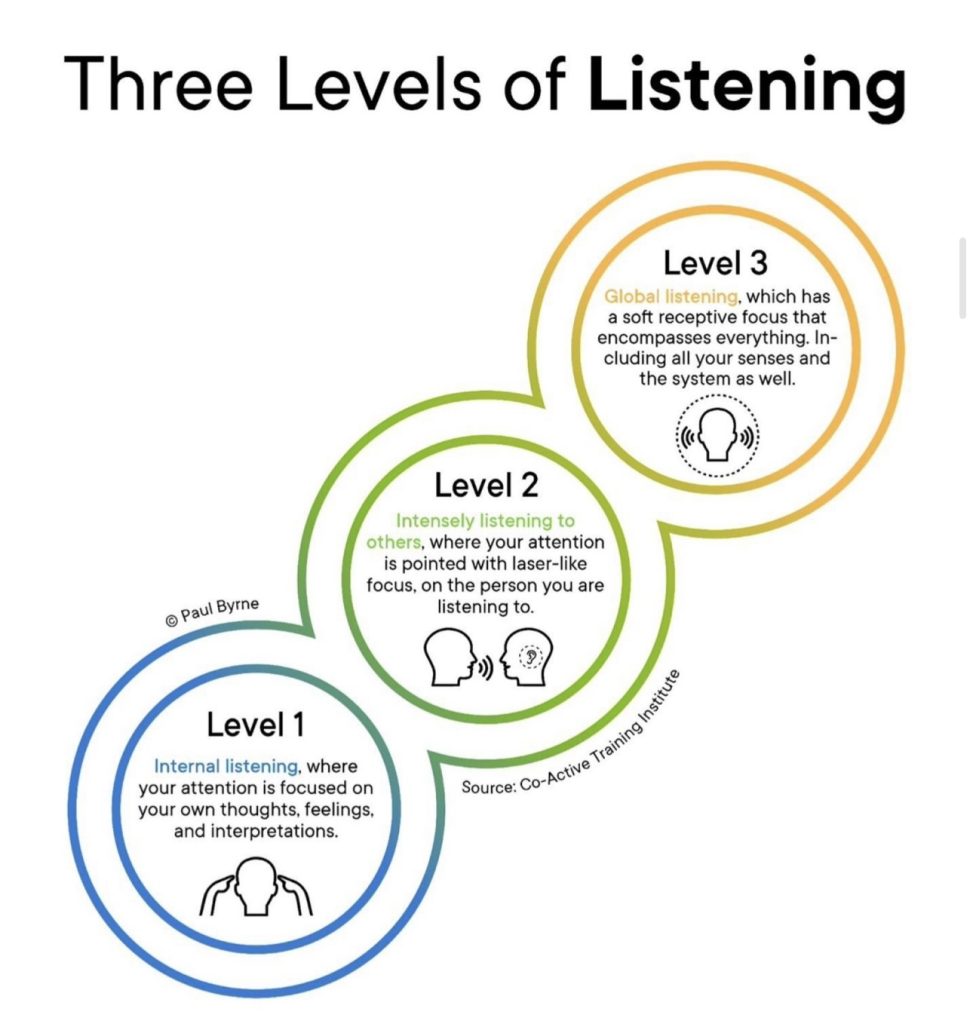
Level 1: Internal Listening
Definition: Internal listening occurs when your attention is focused primarily on your own thoughts, feelings, and interpretations while others are speaking.
We’ve all experienced this: Someone is talking, but instead of truly hearing them, we’re mentally preparing our response, judging their ideas based on our own experience, or thinking about something else entirely.
Common internal listening patterns sound like:
•”I’ve seen this before.”
•”We don’t have time for this.”
•”They’re just being defensive.”
While internal listening is a natural human tendency, it severely limits leadership effectiveness. When stuck at this level, you miss critical information, fail to build trust, and often respond in ways that shut down rather than open up communication.
How to recognize when you’re stuck in Level 1:
•You find yourself formulating responses before the other person finishes speaking
•You feel impatient or dismissive of what’s being shared
•You’re mentally comparing their experience to your own
•You’re thinking about how to solve their problem rather than understanding it
Practical techniques to move beyond Level 1:
1.Notice your reaction without judgment. Simply becoming aware that you’re in internal listening is the first step toward shifting to a more effective level.
2.Practice curiosity over certainty. When you catch yourself thinking “I know exactly what they mean,” challenge yourself to become curious about what you might be missing.
3.Ask yourself: “Why am I reacting this way? What might I be missing?”
4.Create a physical anchor for presence. Some leaders use the sensation of feet on the floor or hands on the table as a reminder to return to present-moment listening.
Level 2: Focused Listening
Definition: Level 2 is intensely listening to others with laser-like focus on the person you are listening to.
At this level, you’re fully present with the speaker, asking open questions, following their logic, and genuinely trying to understand their perspective rather than immediately trying to “fix” whatever they’re sharing.
Level 2 listening creates the experience of being truly heard, which is foundational to psychological safety. When people feel this quality of attention, they’re more likely to share concerns, including potential risks that might otherwise remain hidden.
Key characteristics of Level 2 listening:
•Being fully present with the person
•Asking open questions that expand understanding
•Following their logic rather than imposing yours
•Seeking to understand rather than immediately solve
The impact of Level 2 listening on psychological safety:
When leaders consistently practice Level 2 listening, team members learn that it’s safe to bring forward concerns, questions, and even mistakes. This psychological safety is the single most important factor in team effectiveness, according to Google’s extensive Project Aristotle research.
Practical techniques for Level 2 listening:
1.Avoid interrupting or rushing to solutions. Give people the space to fully express their thoughts, even when it feels inefficient.
2.Sit with discomfort. Many leaders rush to problem-solving because sitting with uncertainty or negative emotions feels uncomfortable. Practice staying present even when the conversation becomes difficult.
3.Ask: “What do they need to feel truly heard?” Sometimes people need validation, sometimes clarity, sometimes just the space to think out loud.
4.Use reflective responses: “What I’m hearing is…” or “It sounds like…” to confirm understanding and demonstrate active engagement.
Level 3: Global Listening
Definition: Level 3 is global listening with a soft receptive focus that encompasses everything, including all your senses and the system as well.
This is where listening becomes truly transformative for leadership. At Level 3, you’re not just hearing the words or even understanding the individual—you’re tuning into the entire system: the emotional undercurrents, the unspoken dynamics, the organizational patterns that shape how information flows.
The expanded awareness of Level 3 includes:
•The unspoken tension in the room
•The cautious silence around certain topics
•The patterns of avoidance in the organization
At this level, you’re listening to what’s not being said as much as what is. You’re attuned to body language, energy shifts, and systemic patterns that reveal deeper truths about your organization’s culture and challenges.
How Level 3 listening transforms risk management:
The most dangerous risks in organizations are often the ones nobody talks about—the “elephants in the room” that everyone sees but no one names. Level 3 listening allows leaders to sense these hidden dynamics and create spaces where they can be safely addressed.
Practical techniques for Level 3 listening:
1.Look beyond loud voices and visible risks. Pay attention to who isn’t speaking and what topics seem to create subtle tension.
2.Watch body language and sense the culture. Notice when the energy in the room shifts, when people exchange glances, or when enthusiasm suddenly dampens.
3.Ask: “What’s not being said? What are we avoiding?”
4.Create silence. Many leaders are uncomfortable with silence, but it’s often in these spaces that the most important truths emerge.
The EiMA Resonant Listening Technique
While the Three Levels of Listening provide a powerful framework, we’ve developed an original technique at Energy in Motion Alignment that integrates all three levels into a practice we call “Resonant Listening.”
Resonant Listening is based on the understanding that effective listening isn’t just cognitive—it’s energetic. Just as musical instruments can resonate with each other’s frequencies, humans are constantly sensing and responding to each other’s emotional and energetic states.
The science behind this is compelling. Research in neurocardiology shows that the electromagnetic field generated by the heart is detectable several feet away from the body and can influence others nearby. Our nervous systems are constantly reading and responding to others’ states, often below the threshold of conscious awareness.
Resonant Listening harnesses this natural capacity for attunement and expands it through intentional practice.
The Four-Step TUNE Method for Resonant Listening
T: Tune into your own energy first
Before you can effectively listen to others, you need awareness of your own energetic and emotional state. This incorporates Level 1 awareness (internal listening) but doesn’t get stuck there.
Practice:
•Take three conscious breaths before important conversations
•Scan your body for tension or activation
•Name your current emotional state without judgment
•Set an intention for how you want to show up energetically
U: Understand the speaker’s emotional frequency
Move into Level 2 (focused listening) with particular attention to the emotional undercurrent of what’s being shared. Beyond the content, what is the energy behind their words?
Practice:
•Notice the speaker’s pace, tone, and physical cues
•Sense the emotional quality beneath their words
•Mentally ask: “What is the feeling tone of this communication?”
•Validate the emotional reality before addressing content
N: Notice the systemic patterns and field dynamics
Expand to Level 3 (global listening) by sensing the broader context and systemic patterns at play. How does this conversation fit into larger organizational dynamics?
Practice:
•Expand your awareness to include the whole room or team
•Notice recurring themes or patterns in communication
•Sense where energy flows freely and where it seems blocked
•Ask yourself: “What larger story is trying to emerge here?”
E: Engage with aligned energy that creates psychological safety
The final step is to consciously align your energy to create a container of safety where truth can emerge. This doesn’t mean matching negative energy, but rather providing a grounded, receptive presence.
Practice:
•Respond at the level of both content and emotion
•Adjust your energy to create balance (calming presence for anxious energy, energizing presence for disengaged energy)
•Use phrases that create expansion: “Tell me more about that” or “I’m curious about…”
•Express authentic appreciation for what’s being shared
How Resonant Listening Creates Psychological Safety
When leaders practice Resonant Listening, they create what psychologist Carl Rogers called “psychological contact”—a genuine meeting between people that transcends roles and allows for authentic exchange.
This quality of connection is particularly crucial when discussing potential risks, giving difficult feedback, or navigating change. It creates a field of safety where people feel they can bring their full intelligence and concerns without fear of judgment or reprisal.
A senior executive who implemented Resonant Listening practices with her leadership team reported: “The quality of our risk conversations completely transformed. People started bringing forward concerns they would have previously kept to themselves. One team member later told me he shared a critical flaw in our expansion strategy only because he ‘felt it was safe to say the hard thing.'”
Transforming Leadership Through Advanced Listening
The impact of moving through the three levels of listening—and integrating them through practices like Resonant Listening—extends far beyond individual conversations. It transforms leadership effectiveness and organizational culture in profound ways.
Uncovering Hidden Risks Before They Become Crises
A global financial services firm implemented advanced listening training for their risk management team after a significant compliance failure. Within three months, they identified three previously undetected risk areas that could have resulted in regulatory penalties.
The chief risk officer noted: “The information was always there, but people didn’t feel safe bringing it forward. When our leaders learned to listen differently, suddenly these concerns started surfacing naturally in conversations.”
Transforming Team Dynamics and Psychological Safety
A healthcare organization struggling with high turnover and low engagement scores focused on developing Level 2 and Level 3 listening capabilities among their leadership team. Six months later, their engagement scores had increased by 24%, and their retention rate improved by 17%.
Exit interviews revealed that the primary reason people stayed was “feeling that my input matters” and “having leaders who really listen.”
Building Cultures Where People Feel “Heard, Noticed, Respected, Understood”
A technology company facing rapid growth and integration challenges implemented the TUNE method with their executive team. They subsequently cascaded the practice throughout the organization.
The result was a measurable improvement in cross-functional collaboration and a significant decrease in the time required to identify and resolve emerging problems. As one team member put it, “For the first time, I feel like I can bring my whole self to work—including my concerns and my ideas for improvement.”
Aligning Team Energy and Emotions Toward Shared Goals
An organization undergoing significant transformation found that their change initiative was stalling despite a solid strategic plan. After implementing Resonant Listening practices, they discovered unaddressed emotional responses to the change that were creating energetic resistance.
By creating space for these emotions to be acknowledged and processed, they were able to realign team energy with organizational goals, accelerating implementation and improving outcomes.
Practical Implementation: Your Listening Development Plan
Developing advanced listening capabilities is a journey, not a destination. Here’s how to begin integrating these practices into your leadership approach:
Self-Assessment: Identifying Your Current Listening Patterns
Start by honestly assessing your current listening tendencies:
•In what situations do you find yourself stuck in Level 1 (internal) listening?
•When do you naturally move into Level 2 (focused) listening?
•Have you experienced moments of Level 3 (global) listening? What enabled that?
•What are your personal barriers to effective listening? (Time pressure? Solution orientation? Status concerns?)
Daily Practices to Strengthen Each Level of Listening
For Level 1 awareness:
•Set a reminder to check your internal state before meetings
•Practice naming your thoughts and emotions without judgment
•Journal about your listening challenges and insights
For Level 2 development:
•Practice asking one more question than feels natural
•Challenge yourself to go an entire conversation without offering solutions
•Ask for feedback: “Did you feel fully heard in our conversation?”
For Level 3 expansion:
•Practice “room sensing” by taking 30 seconds to tune into the energy when you enter a space
•Develop the habit of asking: “What’s not being said here?”
•Create deliberate moments of silence in meetings to allow unspoken thoughts to emerge
For Resonant Listening integration:
•Practice the TUNE method in low-stakes conversations before applying it to challenging situations
•Partner with a colleague for listening practice and feedback
•Schedule regular reflection time to integrate insights from deeper listening
Overcoming Common Barriers to Effective Listening
Digital distractions:
•Create technology-free zones for important conversations
•Practice “device distancing” during meetings
•Model full presence by putting away your own devices
Time pressure:
•Reframe listening as time-saving rather than time-consuming
•Schedule buffer time between meetings for processing and presence
•Start meetings with a brief centering practice
Solution orientation:
•Acknowledge your desire to solve problems quickly
•Practice curiosity statements: “I’m curious to understand more about…”
•Set explicit expectations: “Right now I’m just listening to understand, not to solve”
Status and power dynamics:
•Notice when hierarchy inhibits open communication
•Create structured opportunities for all voices to be heard
•Demonstrate vulnerability by acknowledging when you don’t have all the answers
Creating Accountability for Your Listening Development
•Share your listening development goals with your team
•Ask for specific feedback on your listening effectiveness
•Include listening effectiveness in your leadership development plan
•Consider working with a coach who can observe and provide feedback on your listening patterns
How to Track Progress and Measure Impact
While listening might seem subjective, its impact can be measured through:
•Team psychological safety assessments
•Risk identification effectiveness metrics
•Employee engagement scores
•360-degree feedback on listening capabilities
•The quality and timeliness of information flowing upward in the organization
The Power of Listening as a Leadership Superpower
As we’ve explored throughout this article, listening isn’t just a communication skill—it’s the foundation upon which effective leadership is built. When you master the three levels of listening and integrate them through practices like Resonant Listening, you unlock capabilities that transform your leadership impact:
•You create psychological safety that enables innovation and risk intelligence
•You build trust that strengthens relationships and organizational resilience
•You align energy and emotions toward shared purpose and goals
•You uncover hidden dynamics that might otherwise derail your most important initiatives
The journey to becoming a leader who truly listens is challenging but transformative. It requires vulnerability, practice, and a willingness to move beyond the comfortable certainty of your own perspective. Yet the rewards—for you, your team, and your organization—are immeasurable.
As you develop your listening capabilities, remember that the goal isn’t perfection but progress. Each conversation is an opportunity to practice, learn, and deepen your capacity to create spaces where truth can emerge and people can bring their full intelligence to the challenges you face together.
Begin with curiosity over judgment. Make space for truth without fear. And remember that in a world of constant noise, the leader who truly listens possesses a genuine superpower.
Ready to develop your listening superpower? At Energy in Motion Alignment, we help leaders master the art and science of listening to transform their effectiveness and organizational culture. https://energyinmotionalignment.com/services/ to learn how we can support your development journey.
Frequently Asked Questions
Q: How can I find time for deep listening when my schedule is already overloaded?
A: Rather than viewing listening as another task to add to your schedule, consider it an approach that enhances everything you’re already doing. Start by identifying one or two important conversations each day where you’ll practice more intentional listening. Many leaders find that better listening actually saves time by reducing misunderstandings and preventing problems that would require more time to fix later.
Q: What if I’m dealing with someone who takes too long to get to the point?
A: This is a common challenge that often triggers Level 1 (internal) listening. Try setting clear time expectations at the beginning of the conversation, then practice Level 2 listening within that timeframe. You might be surprised to find that when people feel truly heard, they often become more concise, not less. If time is genuinely limited, you can say something like: “I want to give this the attention it deserves. Can we schedule 30 minutes later today to discuss this fully?”
Q: How do I balance listening with the need to provide direction as a leader?
A: Effective listening doesn’t mean abdicating your responsibility to provide clarity and direction. Instead, it ensures that your direction is informed by a fuller understanding of the situation. Try sequencing your approach: listen deeply first, then integrate what you’ve heard into your direction-setting. This creates both psychological safety and clarity, rather than forcing a choice between them.
Q: Can listening skills really be developed, or are some people naturally better listeners?
A: While some people may have natural tendencies that support effective listening, research consistently shows that listening skills can be significantly improved through conscious practice and feedback. The three levels framework provides specific areas to focus your development efforts, and most leaders see noticeable improvement within weeks of beginning intentional practice.